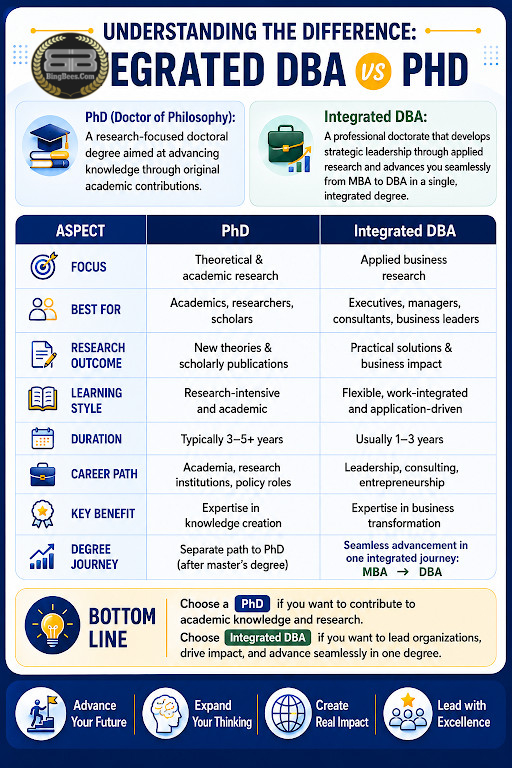


This infographic showcases the comparative analysis of Integrated DBA and PhD, highlighting the primary differences between "Integrated DBA vs PhD”. It serves as a guide for prospective doctoral students who are in dilemma — whether to pursue a DBA or PhD.
At the beginning you will find the clear definition of Integrated DBA and PhD. While the traditional PhD is a research oriented doctoral degree that helps you in advancing knowledge through original academic contributions. On the other hand, Integrated DBA or Doctor of Business Administration nurtures strategic leadership abilities through applied research. It advances you seamlessly from MBA to DBA in a single integrated degree.
The content breaks things down by the degrees across eight key pillars. It contrasts the more theoretical, research heavy angle of a PhD with the flexible, hands-on application driven reality of an Integrated DBA. So a PhD tends to prepare scholars and researchers for a whole lifetime of knowledge creation in academia, whereas the Integrated DBA is made for executives who are after actual business transformation, not just theory.
More importantly, it highlights the structural difference in the student journey: a PhD basically needs a separate road after a master’s degree, while the Integrated DBA offers an accelerated smoother transition directly from an MBA to a doctorate, in just one to three years.
Ultimately, the infographic tells you that the decision depends on your career ambitions — pick a PhD to help develop academic theory, or pick an integrated DBA to push immediate organizational impact. For more details visit : https://lsmt.org.uk/integrated....-doctorate-in-busine